
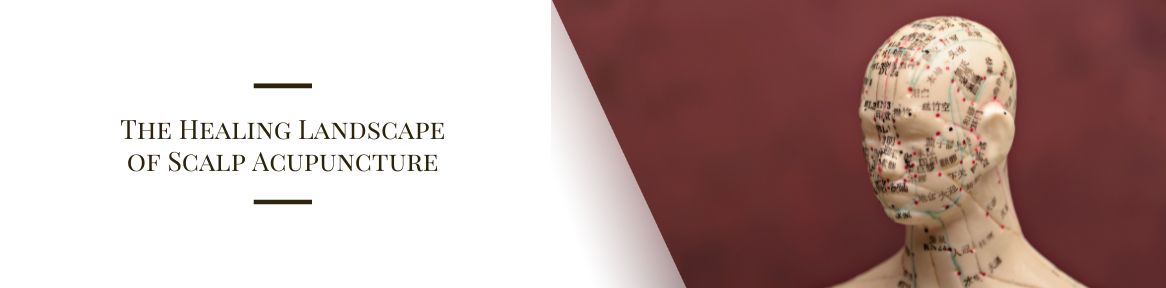
Many healing journeys begin in unexpected places. For some, recovery starts not in the muscles of the back or the ligaments of a knee, but in the quiet landscape of the scalp, an area often overlooked except for styling, washing, and the occasional headache. Yet, for many people seeking relief from neurological, physical, and emotional challenges, scalp acupuncture is becoming a compelling bridge to healing.
Scalp acupuncture is a specialized form of acupuncture widely used for neurological conditions, pain management, and rehabilitation after stroke or brain injury. It blends Traditional Chinese Medicine (TCM) meridian theory with modern neuroscience, targeting zones of the scalp that correspond to functional regions of the brain. Though the technique is relatively contemporary compared to Classical Chinese Acupuncture, it has become a powerful modality for clinicians and patients worldwide.
To understand how this works, it helps to begin with a story.
Understanding Scalp Acupuncture
Scalp acupuncture is grounded in the idea that the brain and body are deeply interconnected, and that regions of the scalp can be stimulated to influence corresponding brain activity. These stimulation zones often align with the functional mapping of the cerebral cortex (the outer layer of the brain responsible for movement, speech, sensation, and more).
This practice draws from two key knowledge systems:
- Traditional Chinese Medicine
TCM theory holds that the scalp is a microcosm of the entire body and that stimulating specific points regulates Qi (the body’s vital energy) along interconnected meridian pathways. - Modern Neuroanatomy & Neuroplasticity
Research now supports the concept that stimulating the scalp can activate brain regions associated with motor control, speech, and sensory perception, leading to improved function through neuroplasticity, the brain’s ability to reorganize and adapt in response to stimulation and training.
Evidence & Clinical Research
- A systematic review found that scalp acupuncture significantly improved motor recovery in stroke patients when combined with standard rehabilitation techniques compared to rehabilitation alone.
- Scalp acupuncture has also been shown to reduce inflammation and modulate brain signaling associated with pain and emotional stress.
These effects occur because acupuncture is believed to stimulate nerve fibers, enhance cerebral blood flow, and impact neurotransmitter release. The result: the brain becomes more responsive and adaptive, essential in recovery after injury or degeneration.
What Conditions Can Scalp Acupuncture Support?
While scalp acupuncture is not a cure-all, it has been widely used for:
- Stroke rehabilitation (especially hemiplegia and impaired motor function)
- Parkinson’s disease
- Multiple sclerosis
- Chronic pain and neuropathy
- Post-concussion syndrome
- Depression and anxiety (by regulating the limbic system)
- Speech impairments and aphasia
- Movement disorders and tremors
It is particularly powerful when applied alongside physical, cognitive, or speech therapy, enhancing the brain’s ability to learn and re-pattern functional movement.
What a Scalp Acupuncture Session Feels Like
If you’ve experienced acupuncture on other areas of the body, scalp acupuncture feels surprisingly gentle by comparison. The needles used are extremely thin, and they are inserted shallowly, just lightly into the surface of the scalp.
Most people describe sensations such as:
- Tingling or warmth spreading through the scalp
- A feeling of relaxation or mental clarity
- A subtle sense of internal “activation” or awareness
During rehabilitation-focused treatments, movement-based exercises are often performed while the needles are in place, further enhancing neural imprinting.
A Bridge Between Body and Identity
What makes scalp acupuncture uniquely meaningful goes beyond its clinical applications. For many patients recovering from neurological injury or chronic illness, there is a psychological weight to losing control over one’s body.
Movement is independence. Speech is identity. Coordination is agency. To regain even small areas of function is often to regain autonomy, confidence, dignity, and hope. Scalp acupuncture becomes not just a therapy, but a pathway back to oneself.
The Future of Scalp Acupuncture
As research grows, scalp acupuncture is increasingly being integrated into:
- Physical therapy programs
- Occupational and speech therapy plans
- Post-stroke recovery centers
- Functional neurology clinics
- Integrative medicine practices
It is part of a larger cultural shift toward understanding healing as collaborative, where body, brain, and lived experience intertwine. The therapy itself is simple. Its effects can be profound.
Scalp acupuncture sits at a powerful intersection of ancient healing wisdom and modern neurological science. Whether helping someone regain movement after stroke, easing tremors in Parkinson’s, or offering relief from chronic pain, it supports the brain’s ability to relearn, reconnect, and restore.
And perhaps, most importantly; it offers hope where progress once seemed limited.
